2026 Q2 Global Freight Transportation and Logistics Trends
Updated for Q2, our industry professionals compiled freight and logistics trends and market updates for 2026 to help your business stay prepared for the future.
Global Macroeconomic Trends
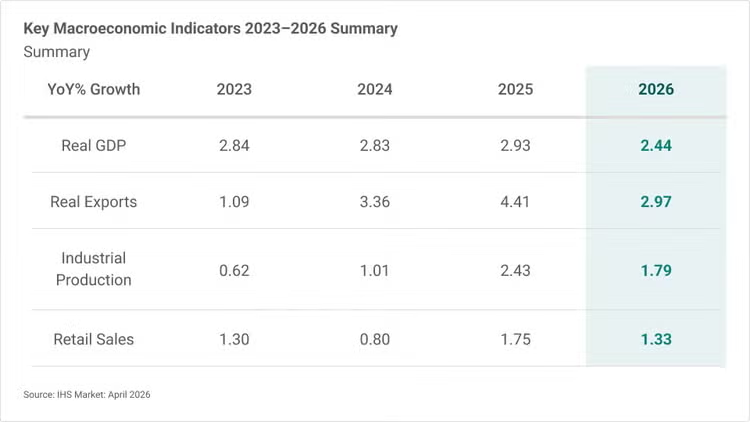
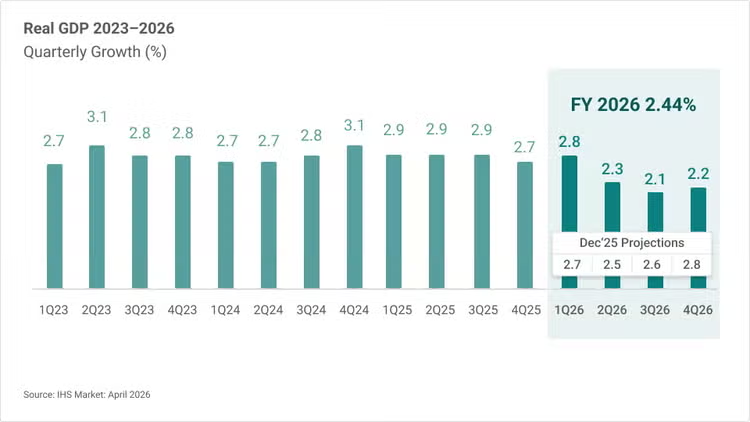
The 2026 global GDP outlook has been revised versus December projections, reflecting changes in the growth profile, with improved export expectations, particularly in APAC, partially offsetting softer domestic demand.
Key Macroeconomic Indicators Summary
Key Macroeconomic Indicators Summary
- Real export projections have been revised up to 2.97% globally, driven by significant increases to projections from the APAC region.
- Industrial production forecasts have declined to 1.79%, with significant decreases from the Middle East region.
- Retail sales forecast lowered to 1.33% from December projections, driven by declines in key regions
Source: IHS Markit: April 2026
Real GDP Quarterly Growth 2023-2026
Real GDP Quarterly Growth 2023-2026
2026 Real GDP Forecast
2026 Real GDP Forecast
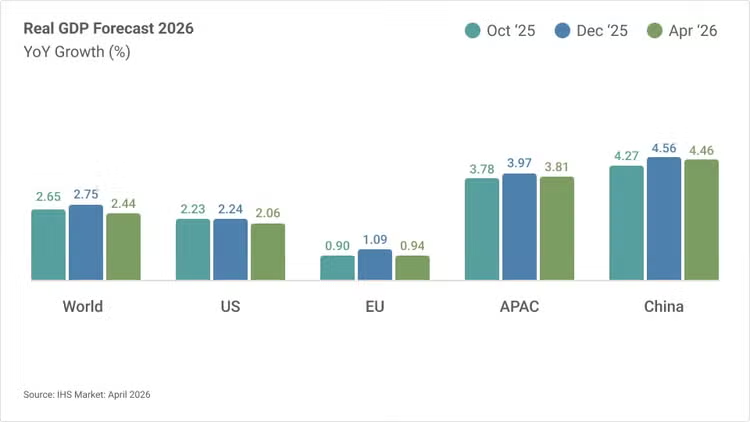
- World GDP growth forecasts for 2026 declined from December 2025, with April projections down across all key regions and global growth of 2.44%.
Manufacturing PMI by Market
Manufacturing PMI by Market
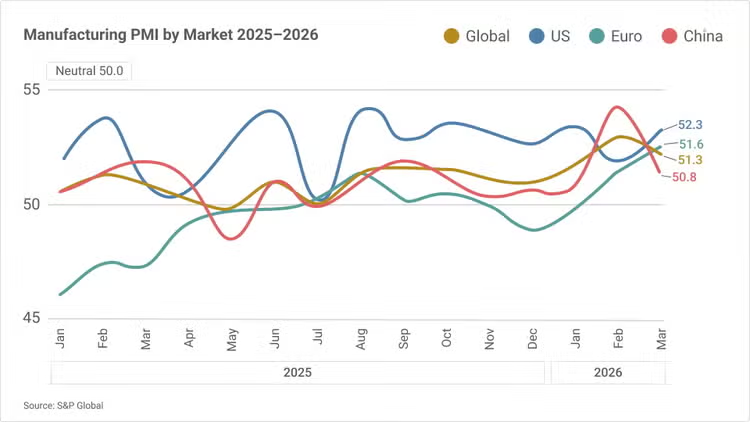
- Global manufacturing PMI dipped in March to (51.3), a -0.6% marked down from the February (51.9) figure with contraction in both output and new orders.1
- US manufacturing PMI grew in March (52.3) from February (51.2) well above the neutral mark (50.0), a reflection of softer growth of output and new orders.1
- Eurozone PMI expanded to 51.6 in March from 50.8 in February coming from below the neutral point in January (49.5).1
- China’s manufacturing PMI dipped to 50.8 in March, declining after a marked uptick in February (53.3) and after the expansion recorded in January (50.3).1
Source: 1) S&P Global
Quarterly CPI Inflation Rate
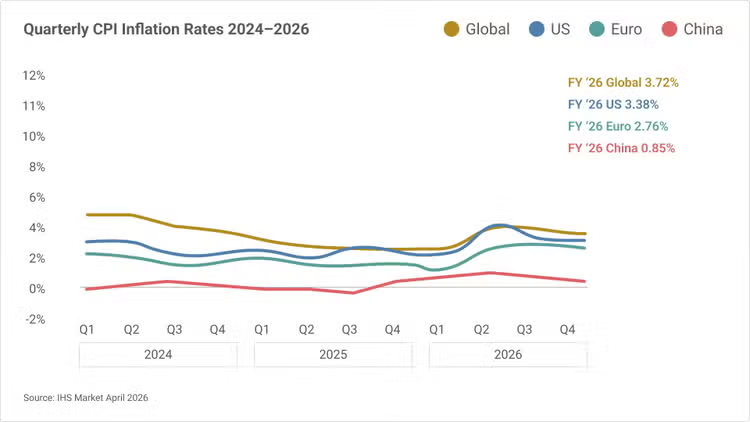
Quarterly CPI Inflation Rate
- The 2026 Consumer Price Index (CPI) inflation rate forecast has increased from previous projections in April.2
- The US inflation rate increased significantly from December projections to 3.38% for the year.2
- The Eurozone inflation forecast increased to 2.76% in April, up from December.2
- China’s inflation projection was also revised up to 0.85% in April, from 0.53% in December.2
Source: 2) IHS Markit: April 2026

Air Freight Industry Update
Global air cargo demand dipped -3.0% Year-over-Year (YoY) in March on the geopolitical disruption in the Middle East but stayed resilient. Capacity still saw major shifts into the “Silk Road” lanes between EU and APAC and away from the Middle East. Global average rates grew +8.7% YoY in March.
Air Freight Demand vs. Capacity
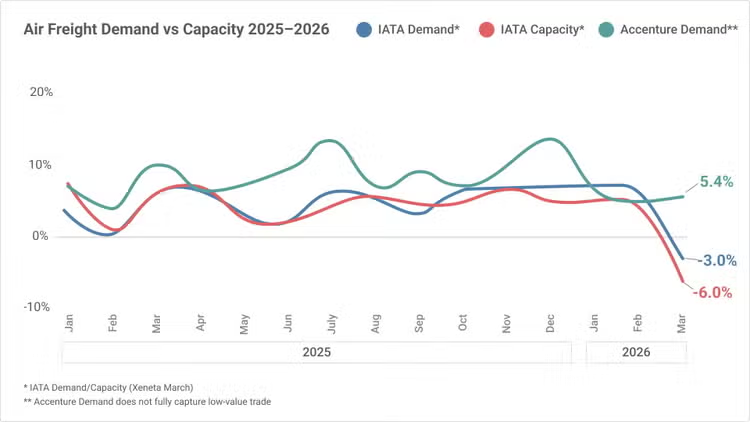
Air Freight Demand vs. Capacity
- Demand dipped -3.0% YoY in March, down from the +6.0% YoY reported in February.4
- Capacity contracted -6.0%, more than the demand dip in March, with increased capacity shifts to the APAC-Europe lanes and away from the Middle East lanes and led to lanes and capacity re-configurations.4
- Demand growth was moderately affected in the short term but continuing geo-political disruptions that affect jet fuel prices and rates have the possibility of impacting airfreight demand going into Q2 2026.4
Sources: 4) Xenata
* IATA Demand/Capacity (World ACD/Xenata December)
** Accenture Demand does not fully capture low-value trade
Air Freight Industry Rates
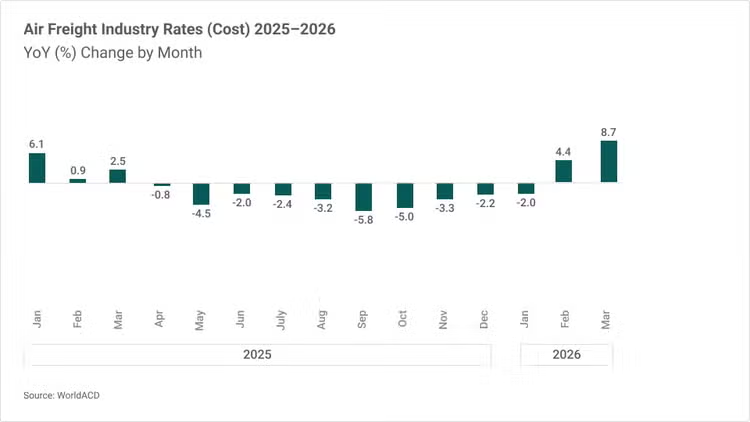
Air Freight Industry Rates
- Average global rates which was a mix of spot and contract rates grew +8.7% YoY in March.1
- Jet fuel price has increased more than twice the position it was before the start of the Middle East disruption, with an upward rates trend most noticeable in the region and spill over to others.1,4
- Capacity constraints, which was primarily the cause of the drive up in rates is being displaced to the second place by the recent increases in the price of jet fuel since the start of the Middle East disruption.1
Air Freight Industry Trends
The Middle East disruption is impacting the air cargo sector, affecting demand, capacity and cost structures and the likelihood of impacting growth forecasts for global demand and capacity in Q2 2026.
- Global Air Cargo had an aggregate demand growth of (+11%) YoY in Q1 2026, with March volume down (-4%) YoY from 2025.4
- Middle East and South Asia (MESA) had the most impact on YoY volume dip in March (-21%), with Africa (-13%), Europe (-5%) and APAC (-4%) the other regions that dipped.4
- February 2026 Year-to-Date (YTD) demand (+9.3%) was driven by Africa (+20%), Middle East (+13.2%), APAC (+11.4%), Europe (+6.7%), North America (+5.7%) and LATAM (-0.6%), the only region that contracted.2
- Of the major routes, Africa–Asia (+61.9%) led the YoY growth. Middle East–Asia (+24%) EU-Asia (+13.1%), Europe-Middle East(+9.3%), Asia-North America and Intra-Asia (+9.1%) & Europe-North America (+5.7%) routes added to the overall+11.6%YoY growth in February.2
Implications: Global demand growth dipped in March on the Middle East disruption and has the likelihood to continue into Q2 with its extension.
Sources: 2) IATA 4) WorldACD
- Global capacity growth which was expected to outpace demand in 2026 contracted to +1.1% Q1 on the Middle East disruption, and the Middle East lanes mostly impacted. EU-MESA (-6%), MESA-EU (0%), MESA-APAC (-3%) and the “Silk Road” lanes with the most gains, EU-APAC (+19%), APAC-EU (+20%), APAC-ISMEA (+2%), making up most of the modest international capacity growth.3
- Widebody belly capacity dipped (-2.4%) while Freighter capacity grew +3.7% in Q1 on the back of the contraction to belly hold capacity from carriers mostly from the Middle East.3
- Global air cargo rates had an aggregate drive up of +16% YoY in Q1 2026 with a (+12%) increase in March, a (+5%) in February and a dip of (-1%) in January.4
Implications: The Middle East disruption with the attendant capacity constraints and jet fuel price hikes drove up rates on the Middle East lanes and with spill over to others.
Sources: 3) Accenture Cargo 4) WorldACD
- Middle East disruption is increasing costs and constraining capacity, supporting higher airfreight rates while pressuring demand outlooks.4
- Global GDP growth forecast for 2026 has been revised downward from the previous more optimistic view (+3.3%) to (+3.1%) on the Middle East disruption.5
- Global Manufacturing PMI contracted in March to (51.3) from the February (51.9) recorded growth. A 0.6% decline but still above the neutral point.5
Implications: The impacts of the Middle East disruption on the air cargo sector are expected to be short-lived. If prolonged, it has the likelihood of adding to the prevailing uncertainties in the market of tariffs barriers & the e-commerce headwinds.
Sources: 4) WorldACD 5) Trading Economics
North American Air Freight Industry Trends
Energy costs and inflation contribute to pullback in manufacturing impacting Less-than-truckload expenses in transportation freight moves.
- Mexican truck exports to the US fell YoY by 5.9% in March signaling a sharp pullback in cross-border equipment flows.1
- Healthcare shippers face sustained LTL cost pressure in Q2 as fuel surcharges and capacity constraints limit pricing flexibility, particularly for replenishment and regional distribution lanes.2
Implications: Cross‑border softening in equipment flows and as healthcare shippers seek solutions to ongoing LTL cost pressures, experienced carriers who can shift priorities will find themselves in advantageous positions to add value in the transportation industry.
Sources: 1) freightwaves.com 2) chrobinson.net
- CASS data shows sequential shipment stabilization but continued rise in expenditures, reinforcing that costs are no longer tightly linked to demand growth.3
- As e-commerce growth slows, other sectors are taking on greater importance; one of the most significant is high-technology manufacturing, particularly semiconductors and hardware linked to artificial intelligence.3
Implications: Freight costs are rising independently of volume as shipments stabilize, while slowing e‑commerce growth is shifting logistics demand and carrier opportunities towards other industries and supply chains.
Sources: 3) stattimes.com
- The U.S. Bureau of Labor Statistics (BLS) reported inflation shock driven by energy is already visible in CPI, with US CPI March +0.9% Month-over-Month (MoM) and +3.3% YoY. Gasoline is also a major driver, up +21.2% MoM.4
- S&P Global’s Mexico Manufacturing PMI data for indicated cost pressures intensified again, driven by tariffs, currency effects and energy inflation, reinforcing upward cost risk in Mexico origin freight.5
- The USMCA (formerly NAFTA) six-year review is actively underway with US, Mexico, and Canada already in pre-review negotiations and bilateral talks. The USMCA mandatory six-year review process written into USMCA formally begins July 1, 2026.6
Implications: Rising energy costs and policy uncertainty from the USMCA review are increasing near‑term cost pressure across North American and cross‑border freight supply chains.
Sources: 4) bls.gov 5) spglobal.com 6) congress.gov
North American Air Freight Overview
Fuel drives higher transportation expenditures higher with US-Iran conflict intensifying energy rates.
Cass Freight Index Shipments 2025-2026
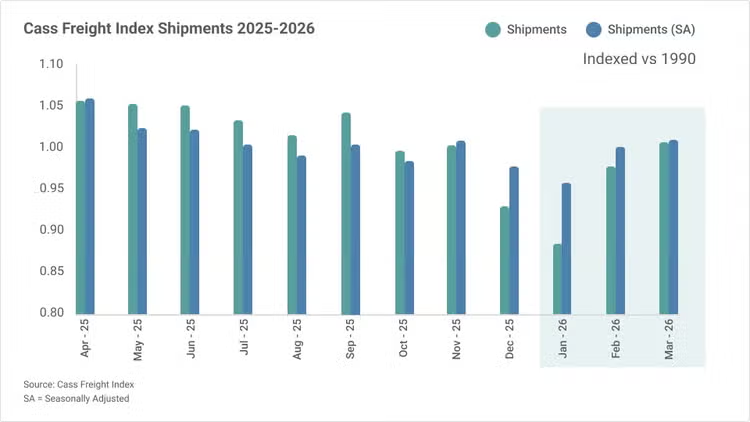
Cass Freight Index Shipments 2025-2026
- Cass Freight Index reported expenditures up 3.0% MoM in March, and shipments increased a total of 5.3% from January to March, increasing the chances of a second recovery in 2026.¹
- Tightness in truckload (TL) conditions is beginning to permeate to other markets which will drive demand in Less-than- truckload.2
Sources: 1) Cass Freight Index 2) S&P Global
Purchasing Managers’ Index
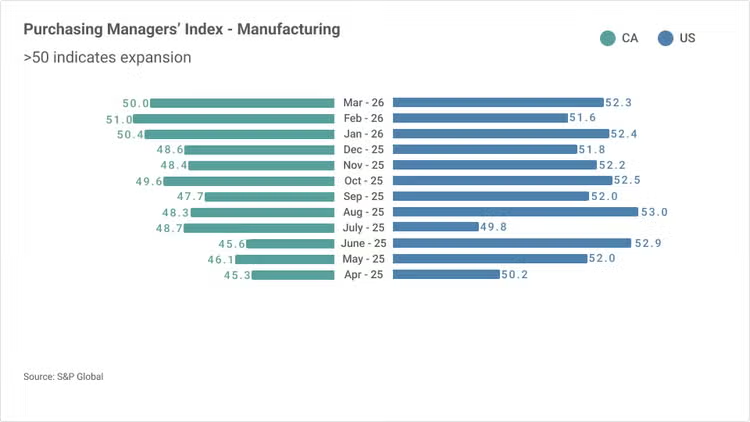
Purchasing Managers’ Index
-
Per the recent S&P Global Market Intelligence report, the US manufacturing sector growth accelerates in March, but inflation intensifies due to conflict in Middle East2
-
Some manufacturers are reporting increasing stock as a precaution against future price rises or supply shortages, underscoring the growing concern about how the conflict might cause problems for factories in the weeks ahead. 2
-
The conflict in the Middle East also had a noticeable impact on prices during March by raising global energy prices.
-
Manufacturers sighted higher expenses due to: 2
- fuel prices had increased
- tariffs continued to push up costs
- inflation picking up to its highest level since August 2025
Sources: 1) Cass Freight Index2) S&P Global

Ocean Freight Industry Update
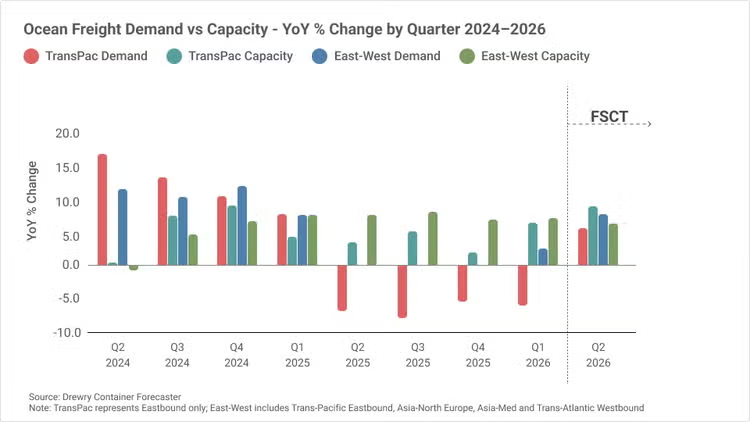
Effective capacity remains constrained due to longer routing and disruption, while demand growth slows. This continues to support rates, but conditions remain volatile and uneven across major East–West lanes.
Demand vs. Capacity
Ocean Freight Demand vs Capacity
- Effective capacity remains structurally constrained. Fleet growth is not fully translating into usable capacity, as longer sailing distances and ongoing disruptions reduce effective supply.
- Geopolitical disruption continues to remove available vessels. Ongoing instability in the Middle East is keeping a portion of the global fleet out of regular rotation, tightening market availability.
- Longer routing absorbs capacity across East–West trades. Diversions and extended transit times are tying up vessels for longer periods, limiting how much capacity is available to the market.
- Market balance remains fragile. Small changes in demand or disruption can quickly tighten or loosen capacity conditions, increasing rate volatility.
- YoY demand growth turns positive in recent quarters. This reflects recovery from earlier demand weakness rather than broad-based strength.
- Demand is stabilizing year over year but remains uneven.Growth reflects normalization from prior lows, while short-term demand remains inconsistent across sectors, particularly retail-driven imports.
Sources: 1) Drewry
Rates
Rates
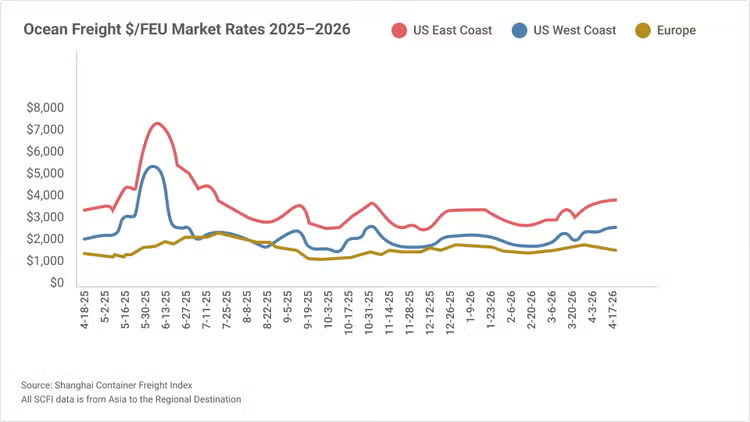
- Rates remain volatile across trade lanes. Spot rates have shown fluctuations following earlier peaks, with trends varying by route and timing.¹
- Rates are supported by constrained effective capacity. Longer sailing distances and ongoing disruptions continue to limit available capacity, supporting rate levels on key lanes.1
- Rate increases are driven by cost pressure. Fuel surcharges range from $30 to $300 per TEU.2
- Demand is moderating, limiting sustained rate increases. Growth has softened following earlier peaks, with weaker demand in key sectors reducing upward rate momentum.1
Ocean Freight Industry Drivers
Disruption and longer routing constrain effective capacity while demand remains uneven in Q2 2026.
- US apparel imports fell 7.2% year over year in early 2026 as retailers manage inventory and demand remains inconsistent.¹
- Household goods imports remain weak due to the housing slowdown and inflation pressure on consumers.2
- Demand varies by sector, with stronger performance in premium segments and pressure in cost-sensitive categories.¹
- Recent disruptions highlight how quickly conditions can shift. The market has experienced multiple unexpected shocks in recent years, reinforcing volatility.8
Implications: Uneven demand limits volume recovery and keeps shipment patterns inconsistent. Shippers may continue to see stable port conditions, but ordering and replenishment decisions vary by sector.
Sources: 1) Cass Transportation Index Report March 2026 2) Journal of Commerce, April 7, 2026 8) Journal of Commerce, April 6, 2026
- Idle fleet remains low, indicating high vessel utilization.3
- 63–75 vessels (340,000–412,000 TEU) are unavailable due to disruption, reducing effective supply.3
- Longer routing and diversions are reducing effective capacity across key trades.3
- Market uncertainty is influencing contracting behavior. Some shippers are delaying decisions or adjusting contract strategies due to unpredictable market conditions.8
Implications: Effective capacity remains constrained, supporting rate stability. Carriers continue managing space through network adjustments, keeping pressure on availability across key lanes.
Source: 3) Alphaliner 13-2026 8) Journal of Commerce, April 6, 2026
- Middle East disruption continues to impact global routing and service design. Vessel diversions and network changes are affecting capacity and transit times.4
- Closure risk around the Strait of Hormuz is driving cargo re-routing. Carriers are shifting flows through alternative hubs such as Colombo, Sohar and Khor Fakkan.5
- Fuel and operational costs continue to influence pricing. Surcharges are applied variably across trades depending on market conditions.6
- Fuel cost recovery is lagging, with a stronger impact expected in Q2 as contracts adjust.7
- Shippers are showing increased sensitivity to rising costs.8
Implications: Routing and transit times remain variable and total landed costs continue to increase. Shippers may need to plan for flexibility and review full cost structures beyond base rates.
Sources: 4) Alphaliner 14-2026 5) Journal of Commerce, April 15, 2026 6) Journal of Commerce, March 18, 2026 7) Journal of Commerce, April 10, 2026 8) Journal of Commerce, April 6, 2026
Customs & Trade Compliance Trends
Rising enforcement, data requirements, and trade policy uncertainty.
- US Customs and Border Protection (CBP) has launched Phase 1 of the Consolidated Administration and Processing of Entries (CAPE) functionality in ACE to begin processing refunds of IEEPA-related tariffs following federal court orders invalidating those duties.1
- New CBP guidance expands Section 232 tariffs on aluminum, steel and copper imports, with additional duties of 10–50% effective April 6, 2026 impacting sourcing conversations with customers.2
- Section 301 is emerging as the primary pathway for future tariff actions. New Section 301 investigations could enable the US to re‑impose or expand tariffs through durable, country‑ and product‑specific measures.3
Implications: Importers should expect phased IEEPA refunds with continued CBP scrutiny and the need for disciplined trade compliance and cash‑flow planning.
Source: 1) CSMS 2) Whitehouse 3) USTR
- United States-Mexico-Canada Agreement (USMCA) will face a trilateral review in July 2026, with outcomes ranging from a 16‑year extension to annual reviews through 2036 if consensus is not reached. Any party may also choose to withdraw with six-month notice. which would effectively end the agreement and likely shift trade to bilateral arrangements.4
- Consumer Product Safety Commissions (CPSC) Certificate of Compliance e‑Filing becomes mandatory on July 8, 2026, requiring certificate data to be submitted electronically via the PGA message set at the time of entry. CPSC has published an updated list of roughly 600 affected HTS codes, but there is no change to product scope or safety standards, only the filing method.5
Implications: Importers should evaluate USMCA sourcing strategies ahead of the 2026 review and ensure CPSC certificate data is entry‑ready and electronically transmittable by July 8, 2026, to avoid delays or holds.
- Canada is tightening its customs valuation rules to clarify which transactions count as the true “sale for export.” Consignment deals, certain non‑traditional sales and some Canada‑to‑Canada sales can no longer be used to determine customs value, meaning some importers may need to use a different valuation method. These changes mainly affect businesses with multi‑step supply chains or Canadian‑based purchasing entities.6
- Effective Dec. 26, 2025, Canada will apply a 25% surtax on imports of certain steel derivative goods like fasteners, wire, mesh, chains and structural components, for commercial-use shipments only.7
Implications: Importers should issue comments to CBSA on valuation and verify steel derivative goods for potential surtax implications.
Global Logistics & Distribution Highlight
Warehouse capacity constraints and slowing utilization are contributing to higher logistics costs and increased pressure on supply chain performance.
Warehouse Capacity Trends
- The Logistics Manager’s Index in the US increased to 65.7 in March 2026, the highest since May 2022, from 61.5 in February, driven by continued expansion in the freight market.1
- Inventory Levels expanded slightly faster (+1.0 to 54.8) and Inventory Costs also moved higher (+8.4 to 76.2, the highest since August 2025)1
- Warehousing Capacity contracted (-4 to 46) and Warehousing Utilization expansion slowed (-0.6 to 59.8) while Warehousing Prices increased (+4.8 to 67.4)1
- Transportation Prices skyrocketed (+12.7 to 89.4, a new high level since March of 2022)1
Implications: Less warehouse capacity, slowing utilization expansion, and higher costs could create headwinds for new business growth, especially for cost-sensitive businesses.
Source: 1) LMI
More From UPS Supply Chain Solutions

UPS Freight Services
At UPS SCS, we’re here to simplify shipping freight. Find the freight service that’s right for you and get your freight moving in the UPS Forwarding Hub.

Latest News
Read the latest freight and logistics news and market updates from the world of supply chain.

Ask an Expert
Questions? We’ll connect you to people with answers. Tell us about you, and choose a topic to get started.