An Importer's Guide to HTS Codes
Learn about Harmonized Tariff Schedule (HTS) Codes, the system of import classification, and how you can apply it to your business.
HTS Tariff Codes Can Be a Confusing Topic Among Shippers
And that’s for good reason. When you’re tasked with classifying your goods from a list of over 21,000 items, it makes sense that many importers may find this system confusing.
But the good news is – this system doesn’t have to be nearly as complex as it sounds. The concept of HTS codes itself is relatively simple to explain. And there are a few quick tips that you can use to help determine how to apply HTS codes to your Canadian import business.
What are HTS Codes? Why Do We Need Them?
To put it simply, an HTS tariff code is a number given to a specific imported item that helps identify and classify it. HTS codes also are used by governments to determine the amount of duty or taxes that must be paid to bring that item into the country. HTS stands for “Harmonized Tariff Schedule”, which is the list of all code classifications for traded goods.
Are HTS Codes International or Unique to Canada?
While the term “HTS” itself can be used to refer to tariff schedules in a variety of countries, the Canadian HTS code (abbreviated HTS) is the set of codes unique to Canada. We will be using the HTS code list as the basis for our examples in this article.
A Classification System
By identifying imports with standardized codes, governments (in Canada, specifically the Canada Border Services Agency - CBSA) can make sure that the correct amount of duty is paid on those items and that there is relative fairness in trade across the board – product codes and duty amounts remain the same, regardless of the company or entity importing the items.
Duty Determination
Classifying imports using the HTS code does more than determine duty, though. HTS codes are also used to track products coming into the country to help keep illegal or dangerous items from crossing Canada borders.

What's the Difference Between a HTS Code and a HS Code?
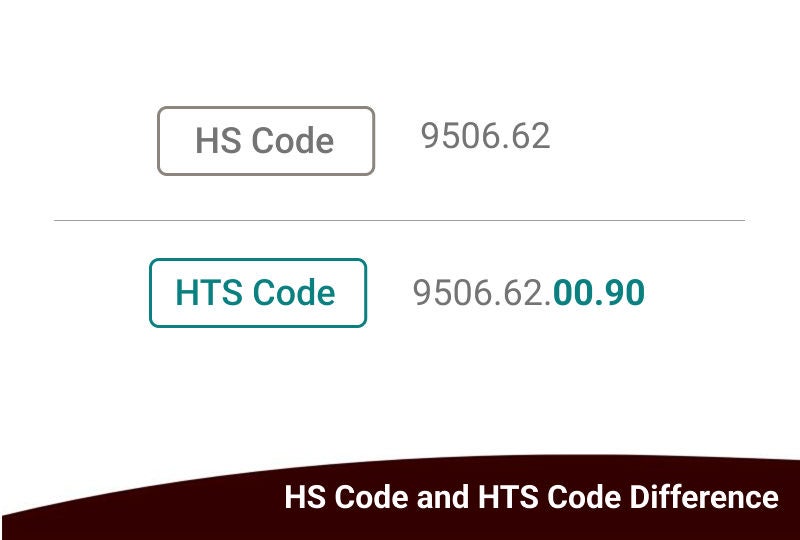
We've discussed HTS codes – but what is an HS code? You can think of HTS codes as localized versions of HS codes. “HS” stands for “Harmonized System”, and refers to the single, universal and global classification system for most traded goods and products.
Let's Take a Closer Look at HTS Codes
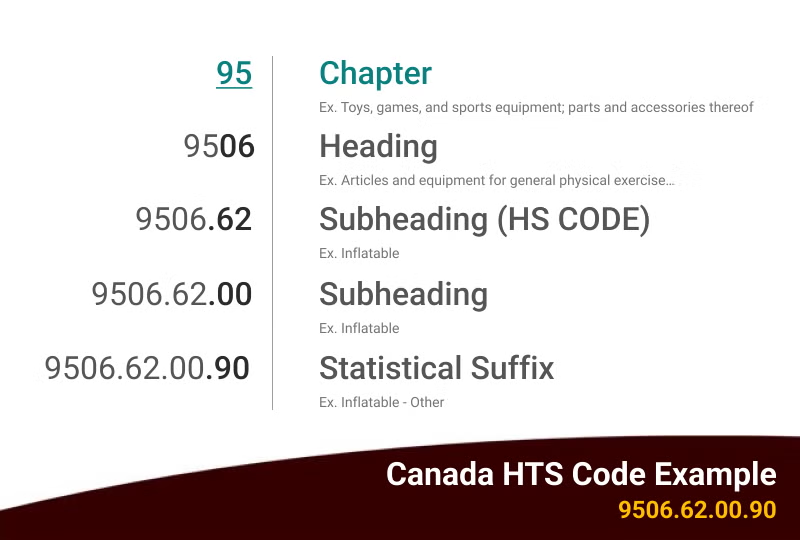
Take a look at the graphics below, using footballs as our example, for a visual breakdown of the elements that make up an item’s HS and HTS codes.
1. Chapter
1. Chapter
Chapters are the first classification layer in the HS code and HTS code systems. There are currently 99 chapters in the international HS code list, grouped into 29 general sections like “Section 20: Miscellaneous Manufactured Articles”, where you will find Chapter 95 for “toys, games, and sports equipment”. An item’s classification chapter is indicated in the first two digits of its HS/HTS code.
2. Heading
2. Heading
Chapters are further divided into headings, which help narrow down the items in the category. For example, “toys, games, and sports equipment” can be subdivided into “Articles and equipment for general physical exercise.”
3. HTS Code/Subheading
3. HTS Code/Subheading
You can see that row three, where you find the six-digit “subheading” for classifying footballs, is the item’s global HS code. These six numbers can be pretty much universally used around the globe on a higher level to classify footballs almost anywhere you ship them.
4. First Canadian Subheading: Rate Line
4. First Canadian Subheading: Rate Line
Moving further down, the eight-digit subheading, sometimes called a “rate line”, is unique to Canada and helps CBSA determine the duty you will pay on the items.
5. Second Canadian Subheading: Statistical Suffix/Category
5. Second Canadian Subheading: Statistical Suffix/Category
The final ten-digit “statistical suffix” or “category” is a more detailed description of the item and is used for trade data collection.
In this example, the eight- and ten-digit codes are what make this a Canada HTS code – these additional numbers on the code are only valid in Canada. Other countries may use the same first six digits (9506.62) to classify footballs, but if those countries have their own tariff code systems, any additional numbers may be different from those we see in Canada HTS code.
Why Does Choosing the Right HTS Code Matter?
- Remember: HTS Codes Determine the Duty You Pay
Using our example of footballs and the Customs Tariff chapter-by-chapter (T2025), there would be a big difference between reporting your pallet of mustard as 2103.30.20. (Prepared mustard), which can be imported at 9.5%, and reporting it as 2103.30.10 (Mustard flour and meal), for which you would pay a 3% import tax.
- Other Countries Won't Recognize Canadian HTS Codes
In addition, you have to be careful not to use Canadian-only HTS codes for items you are shipping to other countries. Other countries have their own variations of HTS codes, and though they may look similar to Canadian HTS codes, they will be different, and the number used to describe an import in Canada may mean something very different in another country. For example, if you tried to ship a pallet of footballs to China, and reported them as 9506.62.00.90, your shipment would be rejected because in China, the code to classify footballs is 9506.62.1000.
- It's the Importer's Duty (Pun Intended)
The Customs Act is the key legislation governing the Canada Border Services Agency (CBSA). It ensures the collection of duties, controls the movement of goods and people, and protects Canadian industry from unfair competition. Modernization efforts are often reflected in amendments to this Act, and it is therefore technically illegal to misclassify your goods. If you are found to be doing so you may face serious fines and penalties as a result.
What is a "Canadian Export Classification" Code?
Simply put, while HTS codes are used to classify imports, Canadian Export Classification codes are used to classify exports.
-
What’s the Difference Between Canadian Export Classification Codes and HTS Codes?
Canadian Export Classification codes are eight-digit numbers used by Statistics Canada to monitor Canadian exports. An item’s CEC is similar to its HTS code, where the first six digits are identical to the international HS code. However, its last two digits may be different. The code lists are not identical, and HTS codes tend to be more detailed, so the HTS code list is a bit lengthier than the list of CEC.
- Are Canadian Export Classification Codes and HTS Codes Interchangeable?
CEC codes are used by exporters in their paperwork and on forms. You can sometimes use HTS codes when exporting (rather than classifying items twice – once for HTS and once for CEC), but CEC codes cannot be used in place of HTS codes for items imported into Canada. For more details about the differences between HTS codes and CEC codes, as well as explanations of when it may be appropriate to use one or the other, visit the Canadian Export Classification site.
How to Determine Your HTS Code
HTS codes narrow descriptions of goods and items down to a very nuclear level. That is generally the point of using them. But that same quality that makes the HTS code greatly efficient at helping CBSA classify imports can also make it very difficult and confusing for shippers to categorize their items.
Here are a few tips to get you on the right track:
Previous Changes to HTS Codes
On January 1, 2022, new changes to the World Customs Organization’s Harmonized System took effect, which added over 70 headings and subheadings, including new classifications for items like smart phones and 3D printers.2 These changes added over 1,500 codes to its list.3
The HS code system is reviewed at least every five years, and the World Customs Organization explained that these changes were made to address new technology and world factors, including provisions for new health and safety equipment, drones and more. Thomson Reuters put together a nice summary of the changes that took place in 2022, which you can view here. And to see how the codes have changed and determine whether a new code is needed to classify your products, check out the World Customs Organization’s 2017-2022 Correlation Tables.
If the thought of trying to choose an HS or HTS code for your goods still seems overwhelming, learn how our dedicated UPS Supply Chain Solutions® Customs Brokerage professionals can help simplify the import/export process for you.
Got HTS codes down and in a hurry to book your next shipment? Visit our UPS® Forwarding Hub to get started now!
2022 Changes to the HTS FAQs
Importers should expect to be contacted regarding potential changes, particularly where the current number is replaced by multiple numbers.
In the electronic HTS environment, all the Participating Government Agencies will need to update their tariff flags to prevent entry rejects.
Importers should review and identify changes that will impact them on a global scale, not just in Canada.
If you maintain databases, you should update them as early as possible and provide updated information to your brokers once the proposed numbers become enacted.
Importers who are also exporters that utilize the HTS in lieu of CBC numbers for export reporting should provide updated databases to their freight forwarders.
1“A Guide to the Harmonized Tariff Schedule of Canada” Guide to tariff classification for Canadian imports: Overview.
2“HS Nomenclature 2022 Edition.” World Customs Organization. http://www.wcoomd.org/en/topics/nomenclature/instrument-and-tools/hs-nomenclature-2022-edition.aspx
3“Recommended Modifications to the Harmonized Tariff Schedule, 2021.” United States International Trade Commission. April 2021. https://www.usitc.gov/publications/other/pub5171.pdf