2026 Supply Chain Outlook

Explore the key economic, trade and global supply chain trends shaping your freight shipping and logistics in 2026.
What We Can Expect in 2026
2026 will be a year of stable but uneven growth, with trade playing a smaller role in GDP across major economies. Domestic demand, tariff dynamics and targeted technology investments will shape planning and performance. For supply chain leaders, resilience—enabled by lane level strategies, multimodal optionality, and end-to-end visibility—will be the decisive advantage.
Key Macroeconomic Indicators 2025-2026
Growth is expected to modestly slow in 2026, driven by easing global trade.
Real GDP YoY Percent Change
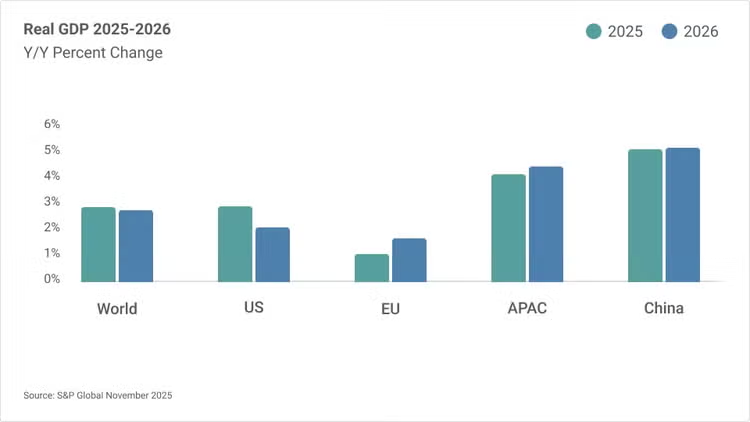
Real GDP growth is projected to slow modestly in 2026 across most regions compared with 2025.
Real Exports YoY Percent Change
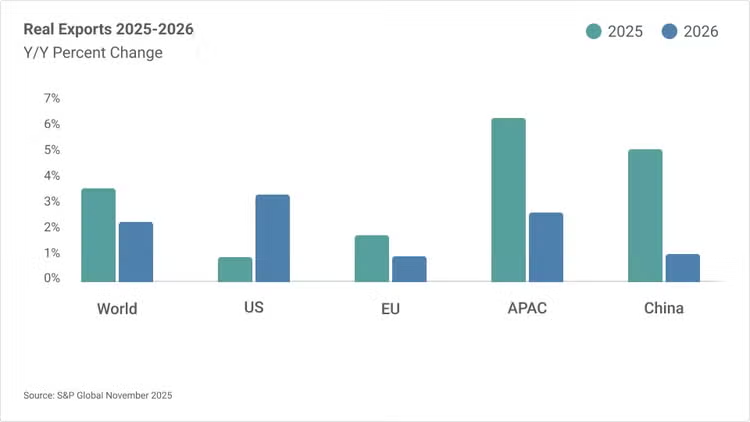
Real export growth is projected to vary by region in 2026, with some regions experiencing slower growth compared with 2025.
Global Air Freight Outlook 2026
Global air freight demand is forecast to grow approximately 2.7% year-over-year in 2026. Growth is expected to be uneven across regions, with Asia Pacific exports and intra Asia Pacific trade leading demand expansion. US outbound air freight growth is projected to be more moderate, particularly on US to Europe trade lanes.
High tech shipments, including artificial intelligence related infrastructure and global eCommerce fulfillment continue to support air freight demand. Regulatory changes impacting cross border eCommerce may alter shipment profiles, but demand for speed and reliability remains strong.
In 2026, air freight strategy will depend less on overall market growth and more on lane specific performance, equipment availability and network flexibility. Shippers moving time sensitive, high value, or technology driven cargo will need reliable access to capacity across evolving trade corridors.
Air Freight Capacity and Rate Trends 2026
- Capacity growth outpacing demand across major global markets
- Downward rate pressure varying by trade lane and aircraft type
- Record utilization levels for dedicated freighter fleets
- Carrier network adjustments toward higher yield and strategic lanes
- Tariff updates, regulatory changes, and trade negotiations will drive rate and capacity volatility.
- Sustainability and emissions initiatives remain a priority, influencing aircraft selection, routing, and cost structures.
- Shifting capacity from Asia→Americas to Asia→Europe may tighten transPacific availability at times.
In 2026, air freight strategy depends less on overall market growth and more on lane performance, equipment availability, and network flexibility. Shippers moving time‑sensitive, high‑value or technology‑driven cargo should secure reliable capacity across evolving corridors and diversify modes (e.g., mixing express/direct with consolidated services) to balance cost and speed.
Global Ocean Freight Outlook 2026
Global container fleet capacity is projected to reach approximately 32.3 million TEU, driven by continued vessel deliveries. The global orderbook now represents roughly 30% of the active fleet, reinforcing long term supply pressure.
Demand forecasts vary significantly by trade lane. Transpacific eastbound volumes are expected to contract while other east west routes may see year-over-year growth. Despite these variations, rates are expected to decline in 2026 as excess capacity persists.
Early 2026 rate forecasts indicate declines of approximately 6% quarter-over-quarter and more than 20% year-over-year on key east-west trades.
- After strong profits in 2024 (~$60B) and materially lower profits in 2025 (~$20B), carriers face a forecasted ~$10B loss in 2026 under current rate and utilization assumptions.
- Expect more blank sailings, capacity control, and reduced schedule reliability, intensifying contract negotiations (particularly Asia→US in Q1).
- Cape of Good Hope reroutes (Red Sea avoidance) have been reducing ~9% of effective capacity at times; limited, cautious reentries to the Suez are being tested, but widespread normalization will require sustained security assurances.
- Northern Europe terminals continue to experience congestion and berthing delays due to labor constraints, alliance port call changes, Rhine river water levels, and weather.
Lower ocean rates offer cost opportunities, but volatility—from blank sailings to routing shifts and congestion—can quickly erode savings. Build flexible routing, LCL/FCL mix and inland connectivity to hedge risk. Consider multimodal strategies and PO/SKU‑level transit analysis to split orders across express air, standard air, preferred LCL and optimized FCL—improving service resilience while managing cost.
North American Supply Chain Outlook 2026
- Tariff volatility expected to persist through 2026
- Expansion of diversified sourcing strategies, including US plus one models
- Mexico strengthening its position as a nearshoring hub for US market access
- Moderate US economic growth paired with cautious freight demand
2026 is a year to prioritize network optionality and flexibility. Businesses that invest in diversified sourcing, multimodal transportation strategies and resilient partner networks will be better positioned to manage policy-driven and economic disruptions.
Logistics Technology Trends 2026
- Artificial intelligence for predictive analytics and operational decision support
- Robotics and autonomous mobile robots improving warehouse productivity and accuracy
- Software-defined warehouses integrating enterprise systems, robotics and real-time data
- Robotics as a service models reducing upfront investment and enabling scalability
- Generative artificial intelligence and digital twins supporting scenario modeling and disruption response
Technology is increasingly critical to managing uncertainty. The ability to simulate scenarios, monitor inventory in near real time and adapt operations quickly is becoming a competitive requirement rather than a differentiator.
Visibility as the Foundation for Supply Chain Orchestration
Data fragmentation across transportation, warehousing and enterprise systems continues to limit decision-making and responsiveness.
- 90% of executives say visibility is vital, yet < one third have achieved it.
- Poor visibility correlates with ~50% higher inventory carrying costs, ~30% longer lead times, and ~15% higher customer complaint rates.
- Only about 60% of companies report full visibility into tier one suppliers, with visibility declining further upstream. This lack of transparency increases exposure to compliance risks, delays and margin erosion.
Visibility enables faster decisions, stronger customer service, and improved financial performance. In 2026, visibility is not just a reporting function. It is a core strategic capability.
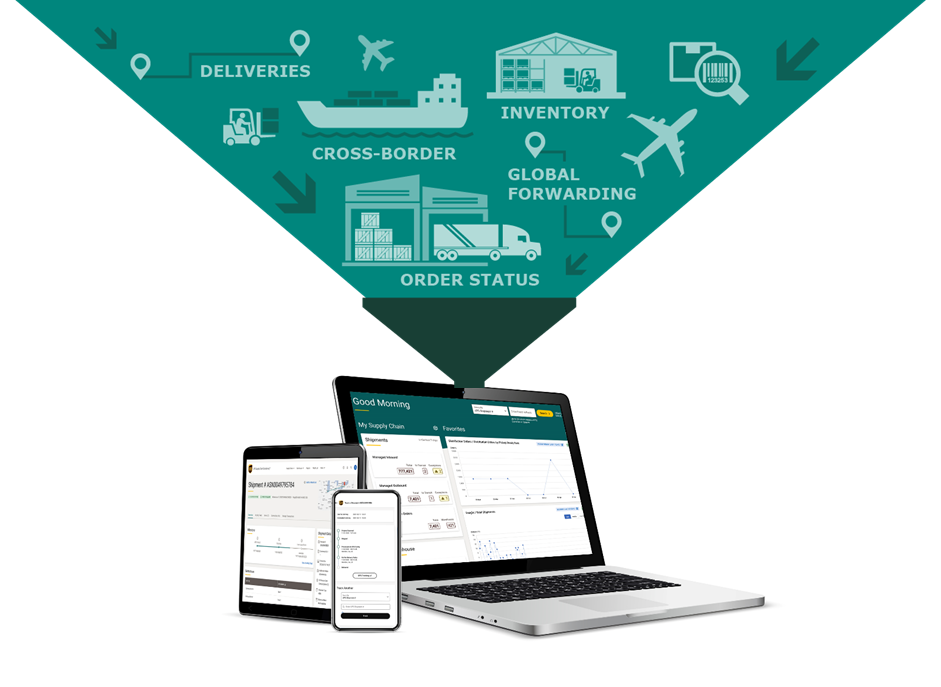
Meet the UPS Supply Chain Symphony™ Platform
Trade and Customs Outlook 2026
Staying Ahead of Tariff and Policy Shifts
Trade policy remains a major variable shaping global supply chains. Understanding tariff changes, regulatory developments and compliance requirements is critical to reducing risk and protecting margins.
Access ongoing insights through our continuously updated article on tariffs and their impact on global trade. For regular analysis, explore the Freight and Logistics Market Update or subscribe to receive biweekly policy and market updates.
Navigate Every Shift in the Supply Chain with UPS
Find the freight and logistics services and solutions that your business needs now, including how to ship your freight online fast.
Air Freight
From urgent, next-flight-out service to door-to-door service within 1-5 business days
Ocean Freight
Full Container Load (FCL) and Less than Container Load (LCL) options for smooth transit across major trade lanes
Ship Online With the UPS® Forwarding Hub
Our all-in-one customer portal lets you get and compare quotes, book and track shipments all on one platform.
Warehousing & Distribution
End-to-end solutions for storing, picking, packing, and shipping, with robust value-added services
Customs Brokerage Services
Efficient export filing and streamlined documentation to help ensure shipments clear customs quickly and accurately
Healthcare Complex Shipping
Cold chain solutions for temperature-sensitive healthcare shipments
Practical Actions for 2026
-
Plan proactively: Lock in longer term contracts and capacity commitments on critical lanes.
-
Split POs by service and mode: Use SKU level transit analysis to mix express air, standard air, preferred LCL, and optimized FCL.
-
Leverage consolidation without sacrificing speed:
- Optimize packaging to reduce dimensional weight and waste
- Explore daily consolidated services to key destinations
- Consider lighter pallets (e.g., cardboard/plastic) where feasible
-
Strengthen cross functional alignment: Connect procurement and logistics teams to avoid single carrier constraints and improve service resilience.
-
Invest in visibility & automation: Prioritize platforms and partners that deliver near real time insights, predictive analytics, and orchestrated execution.
More from UPS Supply Chain Solutions